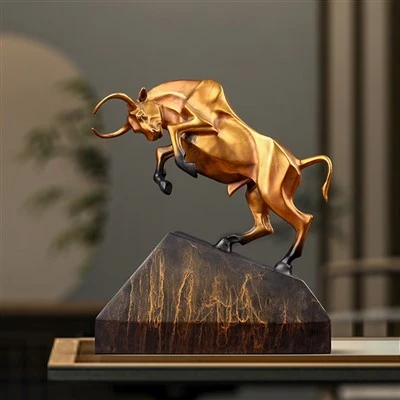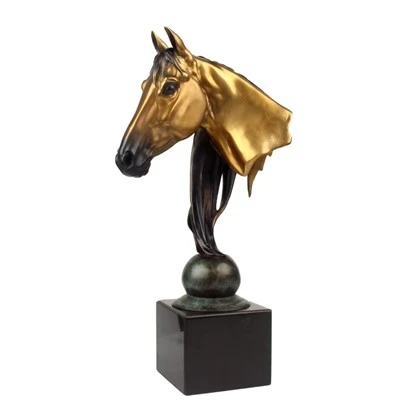
Structurally, bronze statues possess a strong sense of three-dimensionality and stability. Unlike two-dimensional paintings, statues must be sculpted from multiple angles; consequently, their overall form takes into account the visual impact from the front, side, and back. Proportional relationships between the head, torso, and limbs must be maintained, while the arrangement of the center of gravity ensures the work appears stable. This is particularly crucial for statues in standing or dynamic poses, where the handling of support points and the body's center of gravity directly influences the overall effect.
In terms of specific modeling, bronze statues emphasize the connections and transitions between forms. The figure's anatomy-such as the shoulders, waist, and legs-often exhibits distinct undulations, lending the statue natural spatial depth. Details like clothing, hair, and objects held in hand also shift and turn in harmony with the underlying anatomical structure. Since bronze is a material well-suited for rendering intricate detail, artists can enhance the statue's three-dimensional quality through variations in thickness, surface relief, and line work.
From a production standpoint, creating a bronze statue typically involves establishing the overall structure first, followed by the gradual refinement of specific details. For large-scale statues, special attention must be paid to internal support systems and the distribution of structural loads to prevent instability. Post-casting processes-such as surface polishing, finishing, and patination-also significantly impact the final visual outcome. Thus, the structure of a bronze statue is not merely a matter of appearance; it is inextricably linked to the material's properties, the fabrication process, and the work's long-term preservation.